Guide · Retrieved August 20, 2026
Baby name app for couples
Almost every baby name app does the same first job: show you lots of names with meanings and origins. No couple fails at that part. Couples fail because knowing what your partner thinks changes what you think, and because twelve shared favourites are still not a name.
The real problem is not a list
Whoever hears first that their partner loves a name rates it differently from then on. Whoever gave in on the last suggestion is more likely to say no to the next one. A few weeks in, you are no longer discussing names; you are keeping score. That is why "which app has the most names" is the wrong question for couples.
The four questions that count
- Do you swipe separately? And does a name only appear once you both like it, or can you see where your partner stands along the way?
- How much setup does it take? If both of you have to register first, one of you often never gets started, in our experience.
- What happens after the match? Ask whether the app does anything at all once you have matches.
- What does it really cost? Subscription or one-time, with or without ads, and does a purchase cover one phone or both?
What the vendors say about swiping together
| App | What the vendor says |
|---|---|
| Namore (our app) | You swipe separately; a name only appears as a match once you have both said yes independently. A final round follows. Our description, not quoted from a listing. |
| BabyName – find it together | If your partner also downloads the app, you can sync up your phones using a shareable link or AirDrop … |
| Baby Name Together | Each parent swipes independently and privately. The app reveals only the names you both liked — no arguments, no vetoes, just matches.(from the Google Play listing; the App Store listing says “Both parents install the app and link their accounts through email address.”) |
| Baby Name Genius: Swipe Names | Partner matching. Both of you rate names independently. The app finds where your tastes align, from “you both love it” to “worth talking about.” |
| Nameberry | You each swipe independently and see only the names you both love. |
| NameHatch | Invite your partner to swipe in private. When you both like the same name, you’ll get a match notification. |
| Baby Names by BabyCenter | When you and your partner both love the same name, it’s a match! |
Worth noting openly: hidden-until-match voting is not unique to us. Baby Name Together and Nameberry both state it in their own listings, quoted above. What we did not find in the apps compared here is the stage after the match, and that is where the next section starts.
How Namore handles it
What helps when two people decide
It does not stop at the match
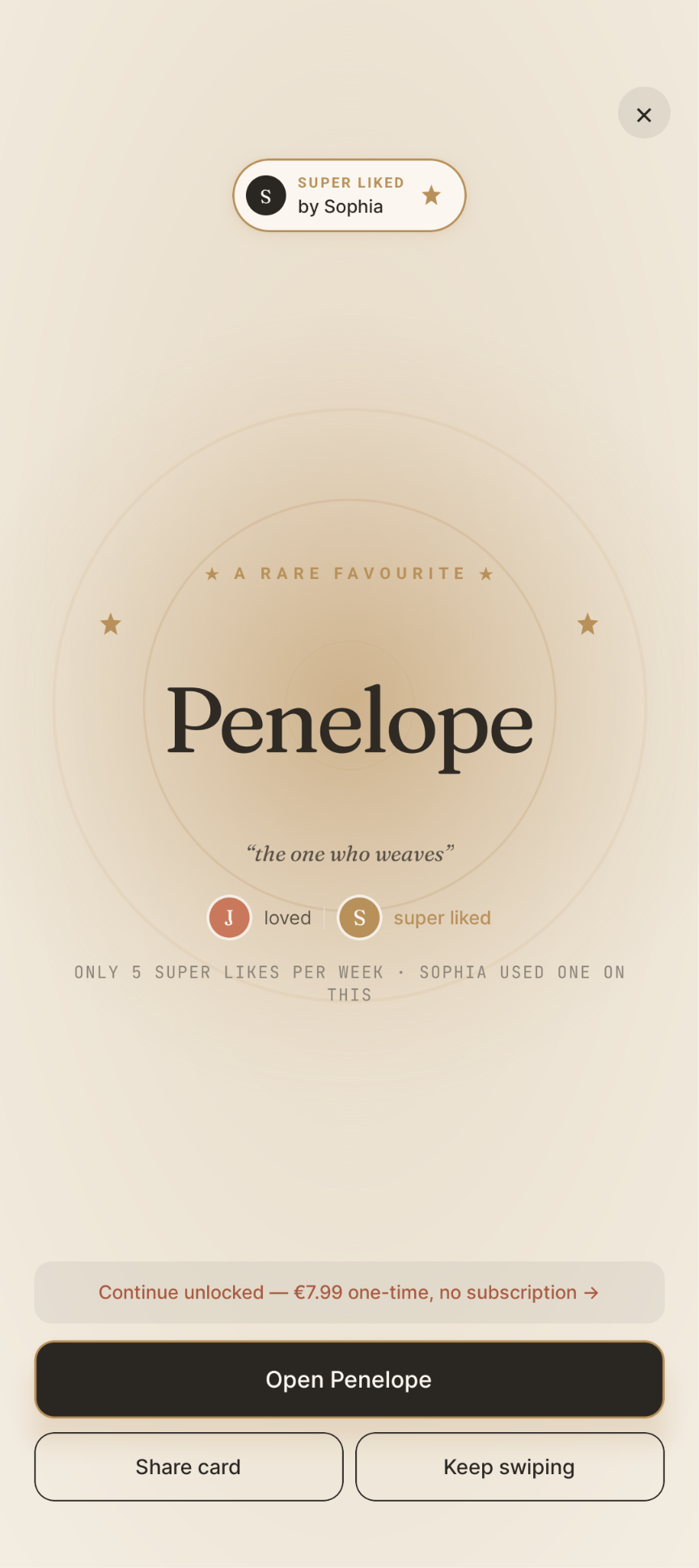
Twelve mutual matches are not a decision. In the final round you each rate the mutual matches again, separately, and what comes out is an order rather than a list. That is where couples usually get stuck. We did not find a comparable stage between the two partners in the apps compared here; several do offer to narrow the match list together, or to let friends and family vote.
One deck for both of you
You swipe the same deck in the same order, built from the countries whose names you want. A name one of you likes reaches the other too, so matches come sooner. What your partner passes on still stays hidden.
For You: ten names a day, each with a reason
Namore puts together ten names for you, each traced back to one you already love, for example “Because you loved Leo”. Swipe through them full screen and double-tap the ones that fit. Two of the ten are picked for the two of you together, and one is a deliberate stretch. The first set is free; with Unlimited a fresh set arrives every morning.
Names from your countries, with their real rank
You pick which countries your names should come from, say the US and Italy. The order follows those countries’ official birth statistics, and every name shows its rank there. Filtering by trend, from rising to rare, is free; showing only the Top 100 or Top 500 comes with the one-time unlock.
A modern interface, and that is not decoration
Choosing a name is something you do on the sofa in the evening, not at a desk. So we built an app that feels like that: one card at a time, quiet colours, large type, nothing flashing, nothing nagging, no ads in between. No forms, no results list, no carousel of unlock offers. Look at the screenshots in the App Store and decide for yourself in two minutes.
No account, no e-mail
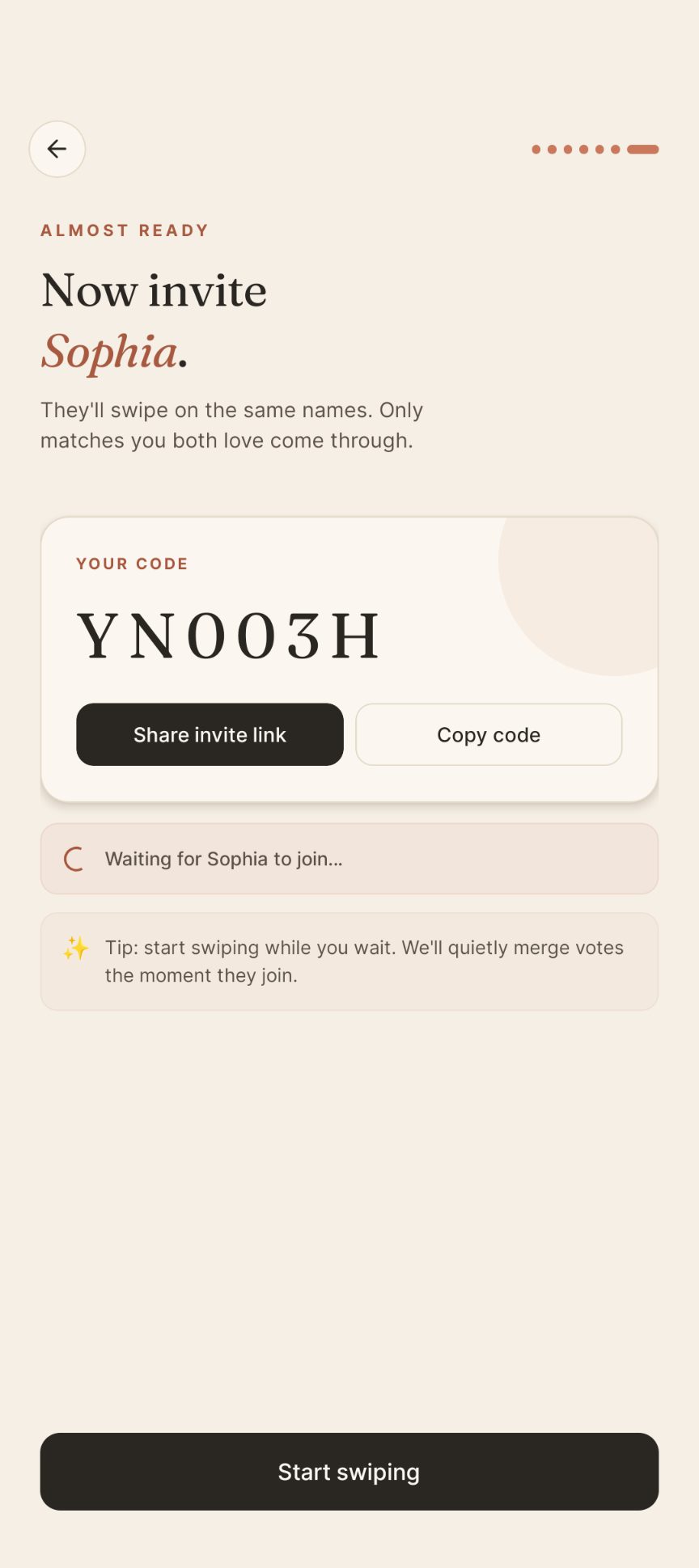
One of you opens a session, the other joins with a six-letter code. It sounds minor, and it is usually the point where one partner quietly drops out: someone who has to register first often does not bother on the sofa at night.
Search, and add your own names
When a name occurs to you that was never in the deck, from a grandmother, a book, out of nowhere, you can search for it or add it yourself. It then appears early in your partner’s deck, without showing who added it, and you only find out what they think when it matches. No asking, no "so… what do you reckon?" Three a day are free.
No name comes back
Anything you have swiped away stays away, after a thousand swipes, after weeks. That sounds obvious and is not: it was the single bug that cost us the most work to get right.
Where Namore is weaker: it is new, on the App Store since May 2026 and on Google Play since August 2026, with few ratings and no community around it yet.
Get Namore for iOS Get it on Google Play
Common questions
- What is the best baby name app for couples?
- Several apps are built for two people: Namore, Baby Name Together, Nameberry, Baby Name Genius, BabyCenter and NameHatch all match partners on mutual likes. The real differences are how you connect (account, email, code), whether the free tier carries ads, and what happens once you have a pile of matches. Namore connects with a six-letter code instead of an account, shows no ads, and adds a final round that turns matches into a ranked shortlist.
- How do couples match on baby names in an app?
- Both partners swipe through the same pool of names, each on their own phone. When you both like the same name, the app shows it as a match. In Namore neither of you sees the other one’s votes at any point before the match, so nobody anchors or vetoes anyone.
- Can my partner see which names I rejected?
- It depends on the app, and most listings do not say. Baby Name Together’s Play listing states that each parent swipes privately and only mutual likes are revealed, and Nameberry says you see only the names you both love. Namore works the same way: your passes stay yours.
- What happens when we match on too many names?
- That is the normal case, and the point where a match list on its own stops helping. Twelve matches are not a decision. Namore adds a final round: you each rate the mutual matches again, separately, and out of that comes an order instead of a list. We did not find a comparable stage between the two partners in the apps compared here.